A Tale of Two Deviations
Day 3 at the Pan American Championships offered an interesting case study in the value of deviating for lift. I made a couple of pretty big deviations and at the time was of course wondering if they would be worth it. Compared to the pilots that were around me at the time it did seem to pay off.
In December 2011, John Cochrane had a very interesting article in Soaring about the value of deviating for lift. I encourage you to re-read it or look it up on the online archive at www.ssa.org. I wanted to take a look at my flight compared to the theory and perform a sort of post-mortem on my decisions. For a little reference, the next day at the contest it was raining so we had a group review of traces. I was scolded a bit by those more experienced than me for taking such a big deviation, even though the traces showed that my flying off course resulted in gaining on the competition around me.
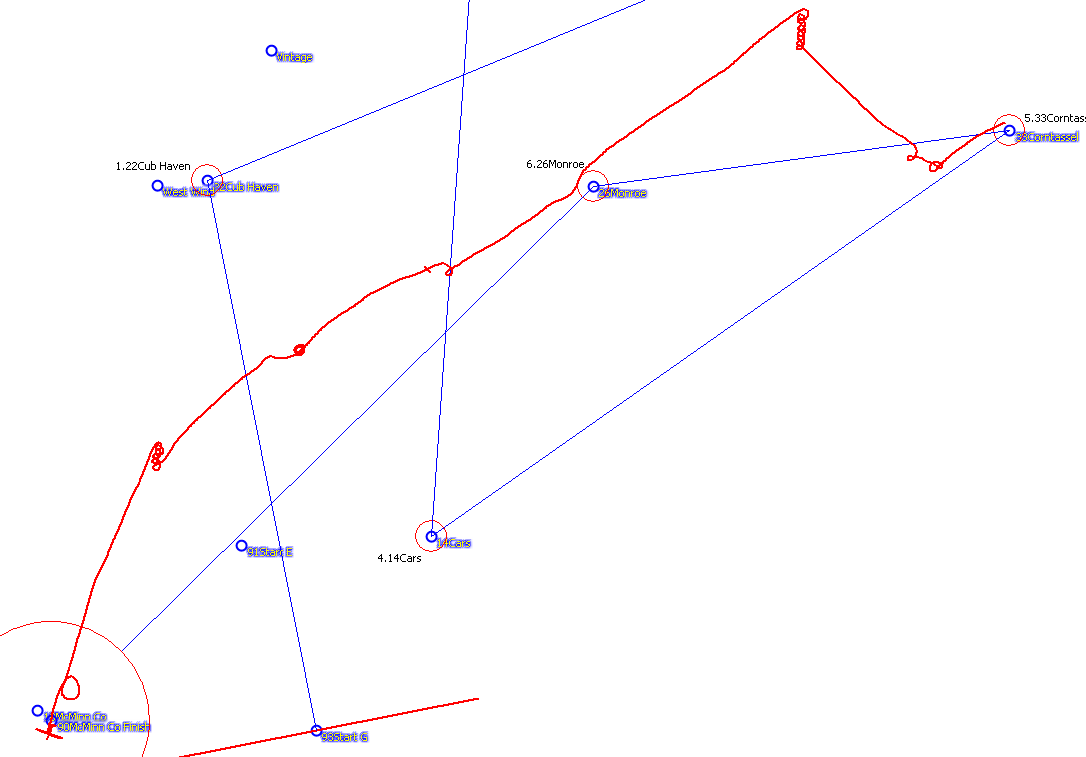
The task was a racing task with 6 turnpoints and a total distance of 153.9 km, so none of the legs were terribly long. The leg from Ferguson to Cars featured a pretty nice cloud street.
My first deviation was after reaching the Cars turnpoint. Leaving Cars, I diverted back for the good looking clouds. The course from Cars to Corntassel is 55°, my diversion was on a course of 14°, a deviation of 41° left of course. My reward for the deviation was a climb of 3.7 knots and an average Netto for the leg of .6 knots. According to Cochrane’s charts, my deviation would be worth it only if the lift on course would’ve been about 2 knots.
The pilots who flew the leg “on course” averaged a climb rate of 2.4 knots, with extremes being one pilot at .7 and another at 3.6 knots. They also averaged a netto of .2 knots. Neither my climb rate in that thermal or my netto alone is quite enough to justify the large deviation, but I think the combination is what made the leg work for me.
During the flight I decided the deviation was worth it based on my performance relative to one of my competitors. We had been wing to wing on the previous leg. He stopped for a 3.5 knot climb and then made a sharp diversion for only a brief climb at 1.2 knots before Cars. About three-quarters of the way down the subject leg, he took a 2.1 knot climb, in which I joined him briefly after my diversion, about 400 feet higher. My feeling after the fact is that my diversion helped me gain on him, but a large part of that was due to his diversion before the turnpoint, and at best kept me even with the rest of the competitors.
Now, Deviation #2! After turning at Corntassel, we headed for Monroe. I saw a thermal being marked by another glider and headed off course once again. That pilot was actually still on his way to Corntassel, taking a very large diversion to do so. On my way off course, I wondered if this was going to put me further ahead of my wingman or allow him to catch back up. Only one way to find out!
The course to Monroe was 262°, my deviation was on a course of 291°, a deviation of 29° right of course. My reward was a really nice 4.4 knot climb. As long as the on-course fliers average less than 3 knots, the deviation should be worth it. Because this leg was very short and some pilots didn’t climb on it, the average for the last two legs combined was 2.2 knots. This deviation was very helpful for me on the last leg, and led to a 4th place finish for the day.